01
Falsifiability
Every construct is written with explicit experimental and computational tests. Scientific rigour is an engineering constraint, not an afterthought.
Professional research portfolio
Pioneering quantum-gravitational computation and intelligence architectures.
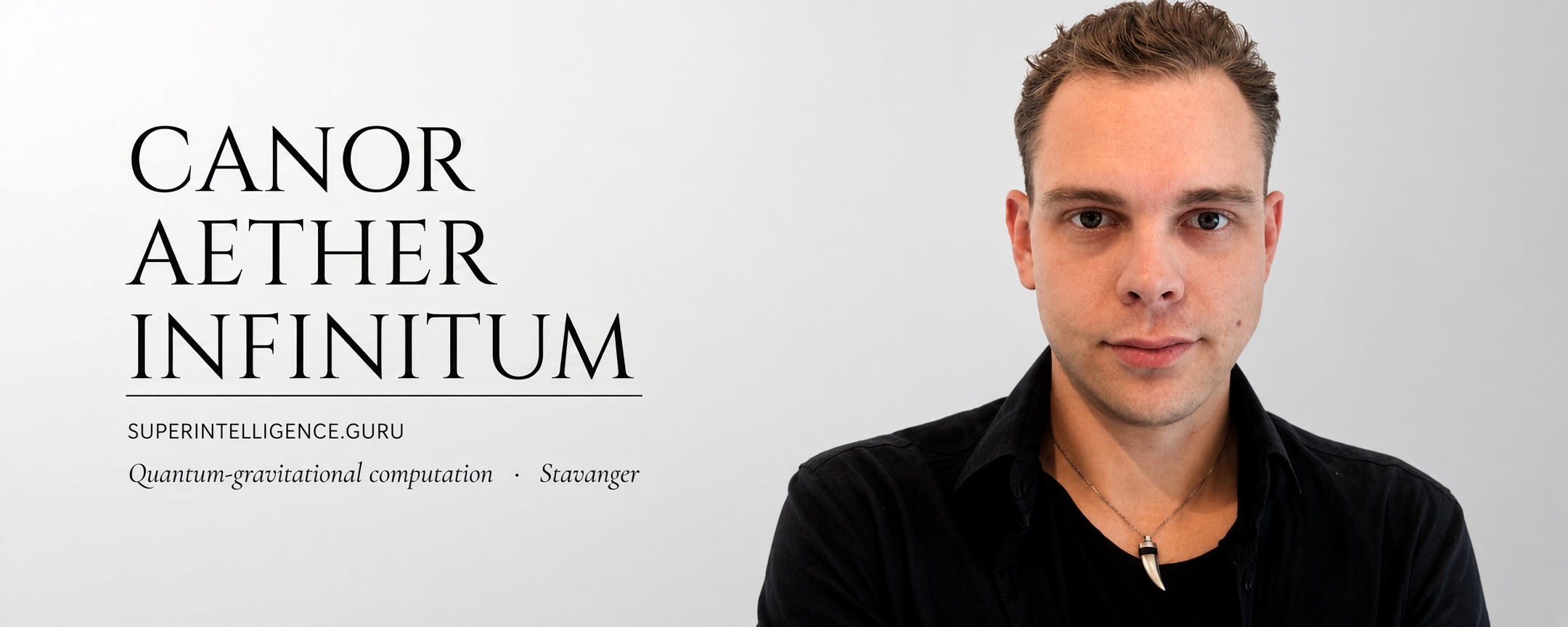
Researcher, systems architect, and entrepreneur. I translate speculative theory into formalisms that can be computed, tested, and deployed — on HPC, on neuromorphic hardware, and inside high-update-rate quantum error correction.
01 — Practice
I am a senior quantum engineer and quantum-gravity technology researcher. Since the early 2010s the work has been independent: research and systems engineering, centered on Diffeomorphic Quantum Gravity and the paired systems that make it executable.
DQG treats quantum gravity as a symbolic meta-computational and communicative system. Selmer–Lie differential forms — Cayley–Dickson–extended Lie brackets — are the local generators. They describe infinitesimal change across imaginary channels, serve as measurement operators in observer-dependent frames, and supply distortion metrics when those frames have to speak to each other.
QGTC carries the runtime. QGCT carries isomorphic signaling. Unruh–Lorentzian frames are the scale-variant contexts in which either one runs. The deployment thesis is deliberately plain: compact, composable formalisms that map onto machines, not Hilbert-space-only abstractions.
02 — Philosophy
01
Every construct is written with explicit experimental and computational tests. Scientific rigour is an engineering constraint, not an afterthought.
02
Cognitive engineering through multi-frame, diffeomorphic models. Parallel field-level ideation, rather than serial idea consolidation.
03
Bridge microphysical quantum models with macro-scale control theory, for terrestrial and extra-terrestrial deployment.
03 — Frameworks
The unification model, the runtime, the signaling layer, and the evaluation stack are one practice. They are separated here only so a reader can enter at the layer they need.
DQG
Unification model
Quantum gravity formalized as a layered meta-linguistic architecture. Selmer–Lie differential forms act as local generators of evolution, as measurement operators in observer-dependent frames, and as distortion metrics for communication between observers.
QGTC
Executable semantics
Runtime semantics for quantum-gravitational computation. Operations are encoded as symbolic primitives suited to simulation, verification, and high-update dynamical quantum error correction.
QGCT
Isomorphic signaling
Communicative semantics for interpretation and signaling, held isomorphic to the computing layer. Unruh–Lorentzian frames are modeled as scale-variant computational or communicational contexts.
SIS
Cross-substrate evaluation
A modular test stack — Sapience, Survivalist, Soldier, Society, System — for emergent cognitive substrates across spacetime scales.
04 — Formalism
Foundational operator · from [UN] Quantum Gravity
∞_nijk := ±Σ_N^∞(±Π_Θ^N(±Ε_Φ^Θ({CD(ℝ) Λ ℝ[N; σ, δ] Λ e Λ ω Λ ε Λ N}_π(Θ)^<π(Φ)ι>)))
The foundational operator. An indexed infinity across the n, i, j, k channels — the author’s name for the whole construction.
Author’s reading of his own notation. It is not offered as standard physics usage, and it is not an independently verified result.
Cayley–Dickson–extended Lie-bracket constructions. Infinitesimal change across imaginary channels, optionally under Ore-skew or surreal scalars.
For detectors in neuromorphic or reservoir-computing substrates, field correlators and global vacuum assumptions are replaced by 3-tuple interval-valued symbolic operations.
DQG is positioned as compact and high-update-rate next to density-matrix error correction, with less global-singularity overhead. This is an engineering claim of the practice, open to benchmark.
05 — SIS framework
Five scales, one evaluation stack. The point is to test an emergent substrate where it actually sits — from a local adaptive system to a channel that has to survive a long mission.
sis.reportMicrophysical / emergent
High-entropy cognition models and parallel field-level ideation that bypass serial idea consolidation.
Individual / local
Resilient systems engineering unconstrained by standard global vacuum assumptions. Self-correcting adaptive substrates.
Tactical / multi-agent
OSINT and GIS fusion. Symbolic quantum-inspired inference for situational awareness and anomaly detection.
Macro / terrestrial
Multi-frame diffeomorphic cognition across populations. Ethics, governance, and verifiable autonomy.
Interplanetary / exascale
Distributed cognition across relativistic and quantum-informed channels. Architectures for long-duration missions.
06 — Selected projects
Follow™ is the software layer. The sensor is the measurement layer. Simulation workloads have been ported and benchmarked across cloud HPC and local clusters.
QGTC stack. A reactive paradigm and symbolic meta-programming language suite.
QGCT held isomorphic to QGTC. A database project for quantum communications.
Plug-and-play quantum-gravity operational scaffolding, using theories of everything as the interface.
Measurement operators with reservoir computing for photonic and phononic event detection.
Simulation pipelines for DQG-aligned error correction, aimed at reducing density-matrix overhead.
Geospatial datasets combined with symbolic quantum-inspired inference for anomaly detection.
07 — Competencies
DQG; Selmer–Lie forms; QGTC / QGCT
Cross-disciplinary proposals across physics, computer science, and communications.
Neuromorphic sensors; reservoir computing; adaptive substrates
HPC and edge-to-cloud demonstrators for pilot programmes.
Deep-tech quantum programming; symbolic meta-computational stacks
HPC codebases, simulators, and prototype toolchains.
Large-scale quantum and post-quantum simulations on cloud and local clusters
Workloads ported and benchmarked for throughput and memory.
Geospatial data, open-source intelligence, and AI inference
Security, environmental, and resilience work.
Sensor architectures and reservoir substrates
Hands-on designs for pilot demonstrators.
08 — Outputs and formation
Reproducible suites and prototype codebases, available on request for consortium review.
Whitepapers on DQG formalisms, Selmer–Lie constructions, and QGTC / QGCT runtime semantics.
A programmatic body of falsifiable models for emergent intelligence, spanning defence, space, and interplanetary societies. A research programme — not a conferred university doctorate.
High-grade upper secondary school, then extreme self-directed study toward quantum-gravity computation and communication. The curriculum vitae records no formal academic degree.
Twelve years and more of independent research across classical, semi-classical, quantum, and post-quantum simulations, on local machines and cloud HPC. Training has been continuous: courses, workshops, and research sprints in quantum programming, HPC, neuromorphic computing, and geospatial AI.
09 — Production workspace
The Follow™ suite is the software layer that turns the research practice into modular toolchains. Marks carried with the work: Follow™ · Redko™ · Avec™ · Fengshui™.
10 — Selected writing
“All Quantum Gravity Technology is based upon P=NP Cryogenic Femtotechnology.”
Named synthesis, in the portfolio’s editorial spelling: Bose–Einstein–Rosen–Boltzmann–Feynman–Turing–Schwarzschild, all in one. The note’s own spelling is preserved on the source page.
Follow™, Redko™, Avec™, Fengshui™ — product and language marks tied to the QGTC / QGCT toolchain.
The note stages a cooperation thought-experiment: operating systems, hardware, and femtotechnology across states, with Norway as host of a singularity-scale research harbor.
A first-language fragment recorded as Norwegian toddler speech — “E det?” (“Is that?”) — later restated as “E det de Quantum Enigma.”
The linked page is the unedited one-page note. It is an authorial source. It is not an independently verified scientific result, and it is kept separate from the claims above.
Read the source note11 — Consortium fit
Deep-tech work packages that need novel computational semantics rather than a wrapper on an existing stack.
Simulation and prototyping tasks, from formalism to a benchmark a partner can rerun.
HPC integration: mapping compact semantics onto clusters, simulators, and prototype toolchains.
Sensor and neuromorphic demonstrators.
Compact computational semantics that map onto HPC and neuromorphic hardware. The aim is lower simulation overhead, faster prototype cycles, and intellectual property a consortium can actually hold.
Horizon Europe proposal writing. HPC benchmarking work packages. OSINT / GIS pilot integration. Dual-use risk and ethics assessments.
Abstract formalisms turned into engineering deliverables. Mentorship of junior researchers. Multi-partner technical integration. Remote or hybrid from Stavanger. EU collaborations are welcome.
12 — Contact protocol
Verified human
Direct correspondence, intended for Canor as a verified human recipient.